
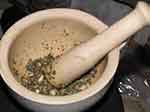
To avoid the artificial (and often toxic) ingredients added to many commercially produced remedies it is easy to make your own home-made remedies tailored to the individual that needs them.
The skin can absorb small molecules of certain substances that are placed upon it and, therefore, using pure natural ingredients is important when the body is already malfunctioning due to allergy, injury, surgery or infection.
Adding to inflammation by using products which include irritants is a fruitless exercise and can cause allergies which can often be misdiagnosed.
Creams
Creams are mixtures of oils or fats with water. Since water and oils are not miscible, it is necessary to add an emulsifying agent that avoids their separation. Creams are therefore stable emulsions of oils or fats. Medicinal properties are added to creams when they use or are made with tinctures, infusions, oil infusions, essential oils or decoctions.
Creams are permeable allowing the skin to breathe and sweat. Their water content and some additional hydrophobic agent like glycerine promotes the hydration and cooling of the skin.
Decoctions
Roots, barks and fruits, being thicker and less permeable than the aerial parts of medicinal plants, do not liberate their active principles by simple infusion. It is necessary to simmer these parts in boiling water in order to extract their medicinal constituents.
The material should be cut or broken into small pieces. In order to avoid losing volatile constituents, use a lid over the simmering pan. After cooling down and separating the solid from the liquid, decoctions can be taken hot or cold.
Essential oils
Essential oils are the volatile oily components of aromatic plants, trees and grasses. They are found in tiny glands located in the flowers (neroli), leaves (eucalyptus), roots (calamus), wood (sandal) and resins (frankincense).
Essential oils are extracted by four main methods: steam distillation, expression, solvent extraction and effleurage. In the first method the oil is extracted by the action of hot steam and then selectively condensed with water from which it is separated. In the second method the oil is extracted by pressure or centrifugation.
In the third method the oil is dissolved in a volatile solvent that when evaporated leaves a heavily natural wax substance called concrete. When separated from the wax, the resulting liquid is called an absolute, the most concentrated form of aroma available.
Effleurage is a longer process involving the dissolution of the oils in animal fat and its separation using alcohol. Although essential oils main usage is in cosmetics and perfumery, many of them do have proved therapeutic properties and are not suitable for pregnant women.
How to make essential oil
Essential oil from herbs is often very expensive to purchase but it is relatively easy to make it at home. To extract the oil from the herbs, the leaves and flowers must be steam-distilled.
Requirements
- Fresh chosen herb leaves and flowers
- Knife
- Ceramic or enamel cooking pot with lid
- Clean brick or canning rack
- Ceramic bowl or heatproof glass
- Filtered or bottled still mineral water
- Ice cubes
- Jar
- Small glass bottle or vial
Method
- Gather the chosen herb early in the morning.
- Rinse and dry and then chop them.
- Crush slightly to release their volatile oils.
- Put a clean brick or canning rack at the bottom of the large cooking pot.
- Place a heat-proof bowl on top of the brick or rack. This will be where the condensed herb vapour will collect.
- Surround the bowl inside with the chopped herbs. They should be halfway up the side of the bowl.
- Pour enough hot water over the herbs until they are immersed in water, but do not spill water into the bowl.
- Turn the burner to high until the water boils, then lower to a simmer.
- Invert the lid of the cooking pot and use it to cover the pot. The upside-down handle will act as a “drip mechanism” from which the condensed vapour can drip into the bowl.
- Place several ice cubes on the outside of the inverted lid, along the centre depression. As older ones melt, continue adding fresh cubes.
- After 3-4 hours, turn off the heat and remove the interior bowl, which is filled with the condensed drops from the vaporised herb water. The product is the herb hydrosol or herbal water.
- Extract the essential oil by pouring the hydrosol into a jar and placing it in the freezer. The liquid portion of the herbal water will freeze, while the volatile oil will stay as it is.
- Pour the essential oil into a small bottle or vial. Seal it and store in a dark, cool place.
Infusions (teas)
Infusions are a simple way of extracting the active principles of herbs through the action of hot water. The preparation of infusions is similar to way we prepare tea. This method is used to extract the volatile components of the dried or green aerial parts of herbs and plants like flowers and leaves.
Infusions may use single herbs or a blend of herbs, vegetables, fruits and spices and are drunk hot or cold. Certainly this is the most common and cheap method of extracting the medicinal compounds of herbs.
Infused oils
Pure vegetable oils such as almond, olive, rapeseed and sunflower are easily found at general grocery stores. They have the property of dissolving the active, fat-soluble principles of medicinal plants. This process is called infusion and can be carried out at room temperature or higher.
Infusion is a slower process than alcohol extraction but has the advantage of resulting in an oil-based solution of medicinal constituents that can easily be used to make creams and ointments. Hot infusion is recommended for the harder parts of the plants such as roots and stems while cold infusion is more suitable for flowers and leaves.
Ointments
Ointments are prepared like hot infused oils, the difference being that herbs are simmered in waxes or fats containing no water. After separating the simmered herbs by squeezing and cooling, the result is a solid mixture of the wax or fat with the medicinal constituents of the plant.
Petroleum jelly, soft paraffin wax and bees wax are some common bases used. Ointments form an oily barrier on the surface of injuries and carry the active principles to the affected area.
Poultice and compress
There are various types of poultices that can be used to treat a wide variety of complaints from acne, arthritis and respiratory conditions to bruises and sprains.
Some people advocate the use of porridge, carrot, bread, milk, potatoes, clay, cabbage and herbal poultices and many use poultices as a home remedy for their horses’ ailments.
A poultice will also help ease out anything that’s embedded under the skin such as wood or metal splinters and can also bring boils or abscesses to the surface and draw out bee sting poison.
A homemade poultice is made by mashing herbs, plant material or another substance with warm water or natural oils to make a paste. Pure pressed coconut oil is especially good to use.
The paste can be applied directly to the skin and covered with a piece of clean cloth. If the herb used is potent such as onion, garlic, ginger, mustard, etc., it is advisable to place a layer of thin cloth between the skin and the herb.
The cloth can then be covered with plastic wrap to hold in the moisture. The poultice should be changed every 3 to 4 hours or more if it dries out. Then the area should be washed with soap and dried thoroughly and left uncovered.
A compress is used the same way but usually warm liquids are applied to the cloth instead of raw cold substances. Tinctures or herbal infusions are great for compresses.
Syrups
With some rare exceptions, like peppermint that is a familiar flavouring agent in toothpaste and chewing gum, infused or decocted herbs are not palatable, especially for children.
In order to disguise their taste, infusion and decoctions can be mixed with honey. These syrups combine the soothing action of these solvents to the medicinal properties of the infusions and decoctions resulting in additional benefits specially for treating cough and sore throats.
Tinctures
Most of the volatile components of medicinal plants and herbs are soluble in alcohol. By immersing dried or fresh parts of plants in alcohol, the active principles are easily extracted at concentrations that exceed those that can be achieved by infusion or decoction.
Highly concentrate solutions that will last for one to two years are a convenient way to store and use medicinal plants constituents. Ideally tinctures should be made using pure ethyl alcohol distilled from cereals. However, since this product is not available to the public, good Vodka with 45-35% alcohol can be used.
The extraction is fairly quick. A 50% mixture of herbs and alcohol kept in a tightly closed jar will hold a tincture ready for use at the prescribed dosage. Never use methyl alcohol, methylated spirits, isopropyl alcohol or any other kind of unknown spirit to make tinctures.
Make your own vanilla extract
Ingredients
- 8 oz vodka
- Six vanilla pods (organic)
Method
Pour the vodka into a jar or bottle labelled with the date and vanilla extract.
Place the pods in the bottle, close lid and allow to stand for six weeks.
This can now be used in recipes that call for vanilla extract.
It will last for at least a year after which the pods will start to lose their flavour.
Related subjects
- A-Z of herbs and spices
- Air-purifying houseplants
- Grow your own health garden
- Natural household cleaning products